Akashi Kaikyo- the longest suspension bridge
A mishap that took place in 1955 when two ferries collided with each other and sank
with 168 victims. This misfortune triggered the Honshu-Shikoku Bridge Authority
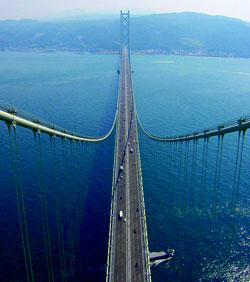
to construct a suspension bridge across the Akashi Strait, which is 3.9km long bridge
built across the Akashi Strait, a 1,500m international shipping canal that connects
the Pacific Ocean to the Sea of Japan. The bridge increased certainty of the transportation
between Honshu and Shikoku even in bad weather conditions and reduced the travelling
time to almost 50 percent. Now the suspension bridge connects the city of Kobe (mainland
of Honshu) to Iwaya (Awaji Island) in Japan. The spectacular view of the bridge
in the night resulted in the name, Pearl Bridge.
The Akashi Kaikyo Suspension Bridge is the longest suspension bridge in the world
and it is probably Japan’s greatest engineering feat. It took two million
workers ten years to construct the bridge, 181,000 tonnes of steel and 1.4million
cubic metres of concrete. The steel cable used would circle the world seven times.
It has six lanes and links the island of Awaji and the mainland city of Kobe, a
distance of four miles.
The width of the strait is about 4km and its maximum depth is about 110m. The utmost
tidal current is about 4.5m/sec (about 9 knots). The surrounding around Akashi Strait
is a well-known fishery area and the Strait is designated as an international channel
by the Maritime Traffic Safety Act in Japan. About 1400 ships daily pass the navigation.
The strait is one of important points at sea.
|
It is one of the longest bridges in the world, and is the world's largest suspension
bridge. Its towers also enter into any book of records. They are 928 feet high,
making it the third tallest in the world, after the Villau Viaduct and the Sutong
Bridge in China. The length of the cables used in the bridge totals 300,000 kilometers.
The bridge was originally designed to be 12,825 feet. But on January 17, 1995, the
Great Hanshin Earthquake stretched the bridge an additional three feet.
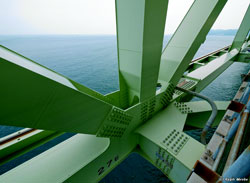
The bridge was designed with a two hinged stiffening girder system, allowing the
structure to withstand winds of 286 kilometers per hour (178 mph), earthquakes measuring
to 8.5 on the Richter scale, and harsh sea currents. The bridge also contains pendulums
that are designed to operate at the resonance frequency of the bridge to dampen
forces. Akashi-Kaikyo Bridge was constructed under such severe natural and social
conditions. The Bridge was designed to resist strong wind, 80m/sec, and great earthquakes
such as an inter-plate type earthquake which predicts to occur around Pacific Ocean
and an earthquake directly above its epicenter like the Southern Hyogo Prefecture
Earthquake in 1995.
The total cost is estimated at 500 billion yen, and is expected to be repaid by
charging drivers a toll to cross
|
 |
the bridge. The toll is 2,300 yen and the bridge is used by approximately 23,000
cars per day. At 2300 yen/car annual revenue would equal 19.5 billion yen.
Construction specifications
Main cables were constructed on the scaffoldings named “cat walk”. The
first foothold of the cat walk was a single thin rope called “Pilot Rope”.
In the conventional construction method, pilot ropes were spanned by ships. For
the Akashi, a helicopter was used for the pilot rope spanning in order not to interrupt
marine traffic in the strait. The day the rope was spanned was memorable moment
when the strait was connected in the first time.
Also, January 17, 1995 is remembered as an important moment. The Great Hanshin Earthquake
hit the bridge on the day. The bridge had towers and cables but no girders at that
time. There was no major damage caused by the earthquake. However, movement of the
seabed increased the center span by one meter.
Construction of the bridge began in May 1988 and took nearly ten years to complete.
The foundation depth of the bridge is equivalent to that of a 20-storey apartment.
Nearly 181,000t of steel and 1.4 million cubic metres of concrete were used in the
construction of the bridge.
Underwater non-disintegration concrete was developed for the bridge's construction
for better fluidity and consistency. More than 100 contractors were involved in
the construction of the bridge. The main contractor was Honshu Shikoku Bridge Authority.
Facts
Carries: six lanes of roadway
Crosses: Akashi Strait[1]
Locale: Awaji Island and Kobe[1]
Maintained by: Honshu-Shikoku Bridge Authority
Designer: Satoshi Kashima
Design: Suspension bridge
Total length: 3,911 meters (12,831 ft)
Height: 282.8 metres (928 ft) (pylons)
Longest span: 1,991 meters (6,532 ft)
Clearance below: 65.72 metres
Construction begins: 1988
Construction end: 1998