Strata SE1 Tower, London
Sustainability winds around Strata SE1
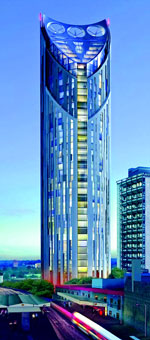
'Strata SE1' is the tallest residential tower in central London and the first building in the world to integrate wind turbines into the actual fabric of the building. 'Strata SE1' is one of the first buildings in the world to incorporate wind turbines as part of its structure. Randoll, the engineering consultancy involved with the Bahrain World Trade Center, which also features wind turbines, was involved in the project. 'Strata', a 147-meter tall residential tower in the centre of London, is the flagship focal point of the £1.5 billion, 170-acre regeneration programme for Elephant and Castle.
The building's three giant turbines are prominently positioned at the top of the building where they are predicted to produce a total of 50MWh a year of electricity. Designed by BFLS (formerly Hamiltons Architects), the £113.5 million tower is the first major private development to be undertaken as part of the £1.5 billion Elephant and Castle regeneration scheme. As the scheme progresses the Strata building will be flanked by two further towers and a host of low rise developments. It contains 408 apartments. Of these, 310 are privately owned and 98 are shared-ownership. The tower offers proximity to the City and thus is in a desirable location in which to live.
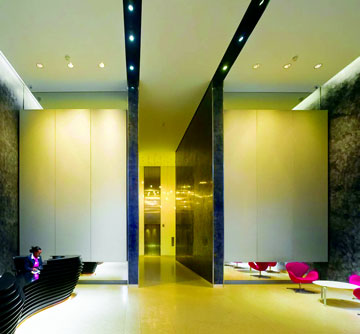
In order to give the sense of arrival, the main entrance of the building looks towards the city and sets back from the main pedestrian walkway. Meanwhile, the double-height lobby reduces the scale, consequently linking the alternation from public to private space. Inside the building, in place of narrow corridors, mini atria offer generous space and light. There are four lifts within the tower: one central lift serves the affordable accommodation only, two high-speed lifts each side serve the basement to level 38 and one high-rise shuttle lift serves levels 38 to 41 in the same central shaft as the low-rise lift.
 |
The affordable apartments are located on floors 2-10 of the tower above the ground floor's two commercial units; they are divided between one, two, and three-bedroom flats. Above the 10th floor the tower contains a mixture of studios, one, two, and three-bedroom flats. The 39th floor features the glamorous-sounding sky lobby with its views over central London, above which are the located the 4 three bedroom duplex penthouses. The 43 storey, wedge shaped building is wrapped in a distinctive black and white chequer board facade. But even more distinctive than its cladding are the 3 giant wind turbines that rotate 148m above the Borough of South wark.
The decision to install the wind turbines dates back to early 2005, when the developers were looking for solutions to the Greater London Authority's planning requirement that 10% of the building's energy demand is meet from on-site renewable energy sources. "It is incredibly difficult to meet the 10% renewable target on a tower in central London" explains project architect Robbie Turner. Along with wind turbines, the design team considered various technologies including photovoltaic panels, ground source heat pumps and solar thermal heating, none of which were appropriate for this project.
Structural Marvel
The towers roof essentially cuts the building at an angle, resulting in a geometric shape that made the steelwork a challenge to construct. This coupled with the sloping roof level, which is formed by an angled elliptical concave surface, a vertical concave surface and two vertical convex off-set surfaces, with three circular openings for the wind turbines, made this a unique structure. The complex geometry of the roof meant that the steel framed structure had to be 17 metres high with 4 curves and 6 elliptical shaped curves made out of circular hollow steel sections. The curved members are joined with 66 members forming the surface to fix cladding. In addition the structure has 400 secondary steel brackets, which were welded to tight tolerances. The elliptical openings for the wind turbines were formed from a total of 30 curved hollow sections, all of which were set out in our fabrication shop using electronic survey data to ensure accurate positioning.
Maintaining Stability
Lateral stability is achieved primarily through a rectangular 9m x 11m concrete core, supplemented by wing walls on the lower 11 levels where they are concealed within apartment party walls. As well as providing stability to the building the core also contains all the common vertical services routes and on-floor metering room. Link beams (lintels) 525mm deep have been used over the three openings in the perimeter of the core at each level. This link beam depth gives sufficient space for services distribution whilst being acceptable structurally. This extra depth was achieved by stepping the floor slab up 80mm within the core with a finishes zone of 10mm compared with the standard 90mm and gaining 80mm depth of critical link beam, increasing the stiffness of the core and allowing a reduction in the core wall thickness.
The wing walls increase the lateral stiffness of the core where it is needed most. In addition the rear wing wall enables the load from the column sitting on the end of it to counteract the tension in the rear of the core caused by two pairs of unbalanced walking columns at the front of the building.
Facets of Wind turbines
Wind power is one of the fastest growing energy technologies in the world. It has been demonstrated commercially over a wide range of geographical conditions, the UK is particularly well placed to exploit it. Sufficient wind is available in the UK to power turbines for about 85 per cent of the year, making UK one of the best places in Europe for wind power. Concern over the environmental impact of the land-based wind farms has encouraged the development of offshore facilities, especially in the urban area. The UK government wants half of the 3500 planned wind turbines over the next decade to be erected offshore and half on land.
London Array is a successful example in this wind power application in a large, densely populated space. Looking towards this, Strata SE1 aims to be a successful icon in applying wind power on the building itself, helping build a secure energy future for the London. The Strata SE1 project team was set the challenging task of designing and delivering an economic and attractive tall building while also delivering the sustainability goals of the local council. A number of options for achieving the mayor’s 10% renewable energy target were examined at the concept design stage and the design team and client concluded that wind turbines represented the best solution given the size and shape of the building, while demonstrating a visible commitment to sustainability.
The three nine-metre wind turbines at the top of the building are rated at 19 kW each and are anticipated to produce 50MWh of electricity per year. They are expected to generate sufficient energy to provide power for the common areas of the building (8% of the energy needs of the building), although questions about their real efficiency will remain unanswered until the completion of two years of comprehensive wind data analysis.
The building exceeds by 13% the current UK regulations relating to sustainability, whilst overall carbon emissions are expected to be 15% lower than the Mayor of London's good practice benchmark. The developers claim that the building will achieve 2050 CO2 target emissions and that (with the Multi-Utility Services Company in place in the area) it will achieve a predicted 73.5% reduction in CO2 emissions when measured against the Building Regulations benchmark.
The energy collected from the wind turbines will be collected by Elephant and Castle Multi Utility Services Company. Through this company, the energy collected from the Strata Tower will serve 5000 homes in the area around as well as the tower itself and thus attempts to provide green solutions to other buildings in an integrated approach.
Wind turbines eventually selected on the basis that the building's height and location could be exploited to enhance their performance. In addition the turbines would make a visible statement by giving the scheme a striking profile. Three turbines were selected as the optimum number, both from an aesthetic and a performance perspective. "We wanted an odd number of turbines," Turner says. However, the larger diameter of a single turbine would have breached the site’s height restriction, while 5 smaller turbines would have given less output and would have been less cost effective.
Despite the prominence of the three 9m diameter wind turbines in the scheme's aesthetic, the electricity generated by them running 24 hours a day is expected to account for less than 8% of the building's total energy consumption. The power generated will actually be used to power the landlord’s services including lifts, lighting, heating and ventilation of the tower's public spaces, underground car and cycle-park. The architects say the actual energy output of the turbines will only be accurately known after two year's wind data.
Sustainability factors
Other sustainable features with Strata include a heat recovery ventilation system, low energy lighting, and a high performance facade with an air permeability leakage rate 50% better than the building regulation. 96% of the waste materials generated during the construction process were recycled.
In addition, provision has been made for connection into the proposed local community combined heat and power system, resulting in further reductions in carbon dioxide emissions. Altogether, it is anticipated that this will result in a 73.5% reduction in carbon dioxide emissions compared the 2006 building regulations for England and Wales.
 |
The mechanical systems include centralised boilers with heat metering to each apartment and grey water recycling. The electrical systems include fibre-optic cabling to each apartment and a display showing the wind turbine power output and carbon dioxide emission reductions. Strata can be seen as an experimental icon that aims to promote the sustainable living and the regeneration of Elephant and Castle over being sustainable itself. The experimental nature is illustrated by Matthew Hewitt, Strata’s project director, "we think it will work, but we don’t know." So it may be excused in its poorer performance than anticipated if it inspires society to produce more effective strategies in the future.The development of Strata SE1 is, to a large extent, a role model for a more eco-conscious society.
It will catalyse the urban regeneration of Elephant and Castle and the implementation of wind turbines on a building's structure. The project is incredibly technically centric in its promotional material and therefore is able to be a model applied globally, as is illustrated by many eco-technical learning projects.
|
Box Item
Client: Brookfield Europe
Main Contractor: Brookfield Construction UK Ltd
Structural/ M&E Engineer, Acoustic Consultants, Fire Engineer: WSP Group
Environmental Advisor: URS Corporation Ltd
Construction Advisor: Brookfield Construction UK Ltd
Planning Supervisor: Construction Project Services UK Ltd
Planning Consultants: DP9
Development Manager: Brookfield Developments UK Ltd
Townscape Consultant: The Richard Coleman Consultancy
Aviation Consultant: Donald Butler Associates Ltd
Wind Engineer: RWDI-Anemos Ltd
Wind Turbine Designer/Manufacturer: Norwin AS
Cost Consultants: Gleeds
Technical Details (fact sheet)
| Floor count |
: 43 |
| Floor area |
: 306,000 sq ft (28,400 m2) GEA / 255,000 sq ft (23,700 m2) NIA
|
| Lifts/elevators |
: 4
|
| Roof Height |
148 m (486 ft) |
Quotes
- The building’s three giant turbines are prominently positioned at the top of the building where they are predicted to produce a total of 50MWh a year of electricity. Designed by BFLS (formerly Hamiltons Architects), the £113.5 million tower is the first major private development to be undertaken as part of the £1.5 billion Elephant and Castle regeneration scheme.
- The affordable apartments are located on floors 2-10 of the tower above the ground floor’s two commercial units; they are divided between one-, two-, and three-bedroom flats. Above the 10th floor the tower contains a mixture of studios, one-, two, and three-bedroom flats.
- . The complex geometry of the roof meant that the steel framed structure had to be 17 metres high with 4 curves and 6 elliptical shaped curves made out of circular hollow steel sections. The curved members are joined with 66 members forming the surface to fix cladding.
- The three nine-metre wind turbines at the top of the building are rated at 19 kW each and are anticipated to produce 50MWh of electricity per year.
- Strata includes a heat recovery ventilation system, low energy lighting, and a high performance facade with an air permeability leakage rate 50% better than the building regulation. 96% of the waste materials generated during the construction process were recycled.
- The energy collected from the wind turbines will be collected by Elephant and Castle Multi Utility Services Company. Through this company, the energy collected from the Strata Tower will serve 5000 homes in the area around as well as the tower itself and thus attempts to provide green solutions to other buildings in an integrated approach.